

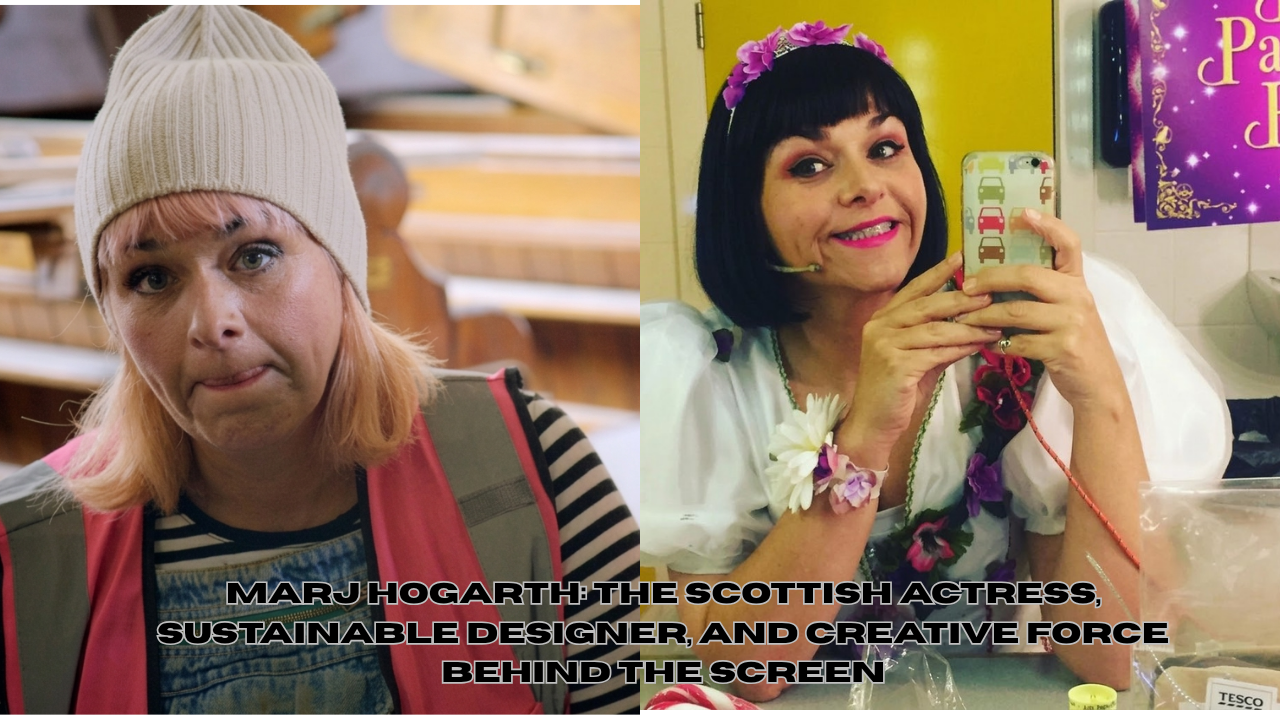
There are rare individuals in the entertainment world who refuse to be confined to a single lane. Marj Hogarth is precisely that kind of person. A gifted Scottish actress, a passionate sustainable designer, a television personality, and an unyielding creative spirit, she has carved out a career that spans decades and disciplines. Whether performing on the Scottish stage, lending her voice and energy to beloved radio and podcast productions, or transforming a crumbling Welsh chapel into a breathtaking home on national television, Marj Hogarth embodies what it means to live a creative life with purpose and authenticity.
Her story is one of persistence, reinvention, and deep-rooted artistic commitment. It is a story that many curious readers — including those searching All About Kim Raver — will find equally compelling, as both women represent something larger than their individual roles: the enduring power of female talent in a competitive entertainment landscape.
Biography Table
| Detail | Information |
|---|---|
| Full Name | Marj Hogarth |
| Nationality | Scottish (British) |
| Profession | Actress, Designer, Television Personality |
| Known For | The Karen Dunbar Show, Still Game, Fags Mags and Bags, Our Welsh Chapel Dream |
| Spouse | Keith Brymer Jones |
| Business | Hook and Hatchet (sustainable bags and crafts) |
| Current Residence | Capel Salem, Pwllheli, North Wales |
| Television Network | BBC Scotland, Channel 4 |
| Social Media | Twitter/X: @Marjorypants |
| Age | Not publicly disclosed |
Early Life and Scottish Roots
Marj Hogarth is a Scottish actress, and her cultural heritage forms the very bedrock of her identity — both as a human being and as a performer. Growing up in Scotland, she was steeped in a rich tradition of storytelling, community theatre, and that particular brand of warm, dry wit that defines much of Scottish creative culture. From a young age, she gravitated toward performance, finding in it not merely a career prospect but a genuine calling.
Scotland’s acting landscape is uniquely demanding and rewarding in equal measure. It carries its own aesthetic — rawer, more grounded, and often more emotionally honest than the polished productions of larger metropolitan stages. Marj Hogarth grew up within that tradition, and it shows in every role she has taken on throughout her career. Her performances are not calculated or artificially constructed; they radiate a natural sincerity that audiences respond to instinctively.
Her theatrical background gave her an exceptionally solid foundation. She has played a range of roles on stage, including iconic pantomime villain roles such as the Wicked Queen in Snow White and Carabosse in Sleeping Beauty at Eden Court Theatre in Inverness, delighting audiences with her commanding stage presence and genuine flair for larger-than-life characterisation. These roles were not throwaway seasonal entertainments but meaningful demonstrations of her range and her ability to embrace complex, theatrical characters while keeping them grounded in human truth.
Breaking Through: Television and The Karen Dunbar Show
The early 2000s marked a pivotal chapter in Marj Hogarth’s professional journey. Her first major television role came through The Karen Dunbar Show, which ran from 2003 to 2006 on BBC Scotland. The programme was a sketch comedy series that became something of a cultural institution north of the border, celebrated for its sharp satirical edge, its willingness to tackle bold subjects, and the remarkable comic versatility it demanded from its cast. For Marj Hogarth, it was both a breakthrough moment and a genuine proving ground.
Sketch comedy is among the most technically demanding forms of acting. Each character must be established instantly, made believable within seconds, and then abandoned entirely as the next sketch begins. There is no room for a slow build, no luxury of character development spread across episodes. Every scene must land with precision. That Marj Hogarth thrived within this environment is a testament to the breadth of her training and the sharpness of her comic instincts.
The show also introduced her to a national audience — or at least, a fiercely devoted Scottish one. Her work alongside Karen Dunbar helped solidify her reputation as a performer who could hold her own in ensemble productions while also generating individual moments of genuine comedic brilliance. Those who discovered her through this programme became loyal followers of her subsequent work, recognising in her a quality of performance that was difficult to define but impossible to miss.
Still Game, M.I. High, and the Art of the Supporting Role
Marj Hogarth also made notable appearances in BBC series including Still Game and M.I. High. Still Game, for those unfamiliar with Scottish television, was a landmark sitcom that ran for years and earned an extraordinarily loyal following across Scotland and beyond. Set in the fictional Glasgow district of Craiglang, it followed a group of elderly friends navigating the comedic and occasionally poignant realities of later life. The show was beloved for its warmth, its sharp characterisations, and its authentic portrayal of working-class Scottish community life.
Appearing in Still Game, even in a supporting capacity, carried genuine prestige within the Scottish entertainment world. It placed Marj Hogarth within a tradition of exceptional Scottish comedy writing and performance — a tradition she had already helped shape through her work on The Karen Dunbar Show.
Her appearance in M.I. High, the CBBC spy series aimed at younger audiences, further illustrated her considerable range. Moving from adult sketch comedy to children’s television requires a different kind of skill entirely — a lightness of touch, a particular energy that engages younger viewers without condescension or artificiality. Marj brought exactly that quality to her work, demonstrating once again that she was not an actress content to be typecast or confined to a single register of performance.
This willingness to move across genres and audience demographics is one of the defining characteristics of Marj Hogarth’s career. Where lesser performers might seek the comfort of repetition, she has consistently chosen challenge and variety over safety.
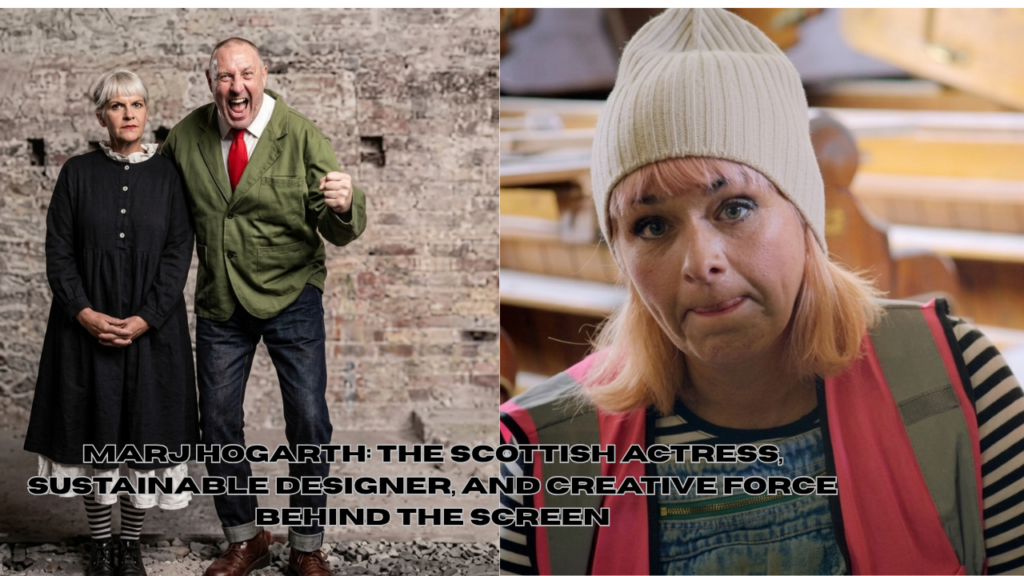
Fags, Mags and Bags: A Long-Running Creative Legacy
Perhaps the most sustained single project of Marj Hogarth’s career has been her involvement with Fags, Mags and Bags. This production ran from 2007 to 2022, spanning 25 episodes across its lifetime — an extraordinary run for any audio production and a testament to the enduring quality and appeal of the work.
The series was rooted in the world of a small Scottish corner shop and the richly drawn characters who populated it. It was warm, witty, and deeply Scottish in its sensibility — the kind of production that rewards repeat listening and rewards long-term investment in its characters. Beginning as a BBC Radio 4 production before evolving into a podcast format, Fags, Mags and Bags demonstrated a remarkable capacity for reinvention and longevity.
For Marj Hogarth, the series represented something beyond a single role. It was a long-term creative commitment, a project she returned to across more than a decade and a half, growing with it and deepening her characterisations over time. In an entertainment industry defined by short engagements and rapid turnover, that kind of sustained investment in a single creative world is genuinely rare and genuinely admirable.
The series also allowed her to develop her voice work and audio performance skills to a high degree of sophistication. Without the support of physical expression or visual storytelling, the voice must carry everything — every nuance of character, every shift in emotion, every beat of comedy. Marj’s ability to construct vivid, believable characters through voice alone added yet another dimension to her already impressive creative toolkit and positioned her as one of the more accomplished audio performers in Scottish broadcasting.
Hook and Hatchet: When a Pandemic Sparked a New Creative Chapter
The year 2020 brought the world to an abrupt standstill. For many performers, the closure of theatres, studios, and production sets meant a forced and deeply unsettling pause. The performing arts community was hit with particular severity, and the psychological toll of sudden enforced idleness was significant for many who had built their entire lives around the rhythm of creative work.
Marj Hogarth responded to that pause not with passivity but with creativity. In 2020, during the UK’s first national lockdown, she rekindled her love of making by launching Hook and Hatchet — a brand producing contemporary, practical, and sustainable bags and crafts for modern life. She began by repurposing materials in imaginative ways, drawing on skills developed across a lifetime of making and designing. She has deliberately avoided trendy labels like “upcycling” in favour of a more grounded, personal approach to design, and each piece reflects her commitment to genuine craftsmanship and sustainability.
The materials she works with carry history. Old clothes, coffee sacks, and other reclaimed fabrics are transformed into functional objects of genuine beauty. The process involves real skill and real time — there are no shortcuts, no mass production, no compromise with the values that make each piece distinctive.
The philosophy behind Hook and Hatchet is worth examining carefully, because it reveals something important about who Marj Hogarth is beyond her public persona. In an era saturated with fast fashion and performative sustainability, where brands plaster buzzwords across their marketing without any meaningful commitment to the underlying values, Hook and Hatchet represents something genuinely different. Each bag is made with deliberate intention — which is, when you think about it, precisely what a great actor creates every time she steps on stage or in front of a camera. In this sense, Hook and Hatchet is not merely a business venture for Marj Hogarth. It is an extension of her creative identity.
Our Welsh Chapel Dream: A Nation Watches a Vision Come to Life
If any single project has brought Marj Hogarth to her widest audience yet, it is undoubtedly Our Welsh Chapel Dream. The Channel 4 documentary series follows Marj and her husband Keith Brymer Jones as they undertake the ambitious renovation of Capel Salem — a derelict 163-year-old Victorian chapel in Pwllheli, on the Llyn Peninsula in North Wales — transforming it into their forever home, a working pottery studio, and a community creative hub.
The couple purchased Capel Salem in 2022 for £200,000. The chapel had been owned by the Presbyterian Church of Wales and had sat on the market for twelve years before Marj and Keith saw in its crumbling walls something that most people would have walked away from. The building had no power, no hot water, and a great deal of structural deterioration accumulated over years of neglect. It was, in almost every measurable respect, a very difficult proposition. And yet, the couple saw in it exactly what they had been searching for.
Series one aired in 2024, series two in 2025, and series three premiered in April 2026 — with each season documenting the ongoing transformation of the building and the lives being built within it. In the third series, Marj and Keith finally move into Capel Salem while continuing to tackle the property’s remaining challenges, including converting damp storerooms into guest suites and constructing a new courtyard. They also make their own gin to celebrate Keith’s 60th birthday and hold a sale of personal belongings to raise funds for the project — touches that add genuine human texture to what might otherwise be simply a renovation programme.
Marj herself captured the spirit of the project with characteristic wit. Ahead of one new series, she told Channel 4 that she would describe the building as now being “off life support and just in high dependency.” It is a line that reveals both her humour and her pragmatism — acknowledging the enormity of the task while refusing to be daunted by it.
Her role in the project is consistently practical and grounding. Her approach complements Keith’s more conceptual and emotional style. She focuses on efficient use of time and resources while embracing the emotional and physical challenges of transforming an historic building — bringing to the renovation project the same disciplined creativity she brings to every dimension of her professional life.
Marj Hogarth and Keith Brymer Jones: A Creative Partnership Built to Last
Any serious account of Marj Hogarth must devote genuine attention to her relationship with Keith Brymer Jones, because it is not merely a romantic partnership but a profound creative collaboration that informs and energises everything both of them do.
Keith Brymer Jones is best known to British television audiences as a judge on Channel 4’s The Great Pottery Throw Down. His emotional responses to the contestants’ work — tears flowing freely at pieces that move him — have become something of a cultural touchstone, a reminder that genuine emotional engagement with art is not weakness but depth. Beyond his television presence, he is a distinguished ceramicist whose award-winning Word Range of mugs, plates, and homeware has become widely recognised across the UK.
Together, Marj and Keith have taken their partnership onto the live stage as well. Their show, presented at venues including The Marlowe Theatre in Canterbury, invites audiences into the world they have built together — sharing stories of clay, craft, and the extraordinary experience of bringing a historic building back to life. The evening features live pottery demonstrations from Keith alongside storytelling from Marj, and the result is described consistently by those who attend as unexpectedly moving and genuinely joyful.
This live show encapsulates something essential about the Hogarth-Brymer Jones partnership. They do not merely coexist; they amplify each other. Marj’s wit and storytelling ability, honed across decades of stage and screen performance, meshes naturally with Keith’s passionate engagement with craft and creativity. The result is an evening that proves two people talking honestly about what they love and how they live can be as gripping as any scripted drama.
The Capel Salem Vision: Heritage, Community, and Creative Purpose
One of the most compelling aspects of the Our Welsh Chapel Dream project is its relationship to community and heritage. Capel Salem is not simply a private home. It is a piece of local history, a Grade II listed building that held significance for the Pwllheli community for generations, and its transformation carries responsibilities that extend well beyond the personal ambitions of its new owners.
The vision that Marj Hogarth and Keith Brymer Jones have for the space is explicitly communal in its ambitions. They intend to create not merely a home but a creative hub — a place where pottery, textile design, and other crafts can be practised, taught, shared, and celebrated. In this sense, the Capel Salem project aligns perfectly with both Marj’s entrepreneurial instincts through Hook and Hatchet and Keith’s long career as both a practising ceramicist and an advocate for the wider democratisation of craft.
The building itself, located on the Llyn Peninsula in Gwynedd, sits within a landscape of considerable natural beauty. The peninsula is one of the most linguistically Welsh parts of Wales, a place where the Welsh language remains central to daily life and community identity. That Marj and Keith chose this location — rather than a more obviously fashionable destination — speaks again to their willingness to embrace challenge and to invest themselves fully in a place and a community rather than simply in a property.
Stage to Screen to Business: Understanding the Full Arc of Marj Hogarth’s Career
Stepping back to consider the full arc of Marj Hogarth’s professional life, what emerges is a picture of remarkable coherence beneath the apparent diversity of her pursuits. From stage pantomime villain to sketch comedy performer, from radio actress to podcast regular, from sustainable bag designer to Channel 4 documentary subject and live theatre co-presenter — each chapter follows naturally from the last, because each is driven by the same underlying values.
Those values — craftsmanship, authenticity, a commitment to making things of genuine quality, and a refusal to take the easy path when a more demanding and more meaningful one presents itself — are consistent throughout. They are as visible in her approach to building a business as they are in her approach to building a character, and they are as evident in her engagement with the challenges of renovating a Victorian chapel as they are in her performances on stage.
Those who come to Marj Hogarth through All About Kim Raver will discover an artist whose story, while different in its specifics, shares the same essential qualities of dedication and creative longevity. Both represent what a sustained, principled career in the entertainment world can look like when the work is always placed first.
What Sets Marj Hogarth Apart in British Entertainment
In a media landscape that frequently rewards spectacle over substance, Marj Hogarth has built her reputation on the opposite principle. She does not seek the largest roles or the most prominent platforms. She seeks work that is meaningful, characterful, and honest — and she brings that same integrity to everything she undertakes, whether it is a sketch comedy performance, a podcast recording session, or a hands-on renovation project broadcast to a national television audience.
Her authenticity is unimpeachable. She never appears to be performing for the camera when the camera finds her, even in a documentary setting. Her comedy is rooted in character rather than cheap effect. Her willingness to be genuinely vulnerable — to share the exhaustion, the doubt, and the occasional despair of the chapel renovation project — makes her remarkably easy to root for as a public figure.
What sets her apart, ultimately, is not any single talent or achievement but the integration of all her talents into a life that is visibly and consistently her own. She is an actress who became a designer who became a television documentary subject who became a live stage performer — and throughout all of it, she has remained recognisably, unmistakably herself.
Marj Hogarth as a Model for Creative Reinvention
There is a broader lesson in Marj Hogarth’s career trajectory that extends well beyond the entertainment industry and speaks to anyone navigating a creative professional life in an era of rapid change. She has never treated her creative identity as a fixed thing. When theatre led to television, she adapted. When radio led to podcasting, she adapted. When the pandemic closed every professional door available to a performing artist, she built a new one entirely — launching a sustainable craft business from scratch with nothing more than skill, passion, and determination.
This capacity for reinvention without loss of identity is the mark of a genuinely mature creative practitioner. At each stage of her career, Marj Hogarth is recognisably the same person — curious, warm, determined, funny, and deeply committed to making things that have real value. Whether those things are comic characters, handcrafted bags, or a restored Victorian chapel, the underlying creative philosophy remains constant and coherent.
For young performers and creative professionals watching her journey unfold across stage, screen, podcast, documentary, and live performance, that consistency is perhaps the most valuable thing she models. Talent matters enormously. Training matters. But it is the willingness to keep showing up, keep reinventing, and keep believing in the work that separates a long and meaningful career from a brief moment of recognition.
Frequently Asked Questions About Marj Hogarth
Who is Marj Hogarth? Marj Hogarth is a Scottish actress, sustainable designer, and television personality best known for her roles in The Karen Dunbar Show, Still Game, and the long-running podcast series Fags, Mags and Bags. She is also widely recognised for starring alongside her husband Keith Brymer Jones in the Channel 4 documentary series Our Welsh Chapel Dream.
What is Marj Hogarth best known for?
She is best known for her acting career across Scottish television and stage productions, her fifteen-year involvement with the podcast Fags, Mags and Bags, and her more recent television appearances on Channel 4’s Our Welsh Chapel Dream, now in its third series.
Who is Marj Hogarth married to?
Marj Hogarth is married to Keith Brymer Jones, the distinguished British ceramicist and judge on Channel 4’s The Great Pottery Throw Down. The couple are also creative collaborators and co-stars of Our Welsh Chapel Dream.
What is Hook and Hatchet?
Hook and Hatchet is a sustainable craft and bag-making business founded by Marj Hogarth during the 2020 lockdown. The brand produces contemporary, eco-conscious bags and accessories crafted from repurposed and reclaimed materials, reflecting Marj’s commitment to craftsmanship and sustainability.
What is Our Welsh Chapel Dream about?
Our Welsh Chapel Dream is a Channel 4 documentary series following Marj Hogarth and Keith Brymer Jones as they undertake the ambitious renovation of Capel Salem — a derelict 163-year-old Victorian chapel in Pwllheli, North Wales — transforming it into their home, a working pottery studio, and a community creative hub.
How many series of Our Welsh Chapel Dream have aired?
As of April 2026, three series of Our Welsh Chapel Dream have aired on Channel 4. The third series premiered in April 2026 and follows the couple as they finally move into the chapel while continuing its transformation.
Is Marj Hogarth active on social media?
Yes. Marj Hogarth is active on X, formerly known as Twitter, under the handle @Marjorypants, where she has engaged with audiences over the years and shared moments from both her professional and personal life.
What theatre work has Marj Hogarth undertaken?
Marj Hogarth has an extensive stage background, including notable pantomime villain roles such as the Wicked Queen in Snow White and Carabosse in Sleeping Beauty at Eden Court Theatre in Inverness, as well as various other productions throughout Scotland and the wider United Kingdom.
How is Marj Hogarth connected to the keyword All About Kim Raver?
Those who search for All About Kim Raver are often interested in the biographies of talented, versatile women in entertainment with long and substantive careers. Marj Hogarth fits naturally into that category — a performer whose body of work, creative reinvention, and authentic public persona make her equally worthy of in-depth exploration and appreciation.
What makes Marj Hogarth a creative role model?
Her career trajectory — spanning stage acting, television comedy, radio, podcasting, sustainable entrepreneurship, documentary television, and live stage performance — makes her a compelling example of creative reinvention and sustained artistic commitment. She has demonstrated that a creative identity need not be fixed or narrow, and that authenticity and craftsmanship carry genuine value across multiple disciplines and across the full length of a career.
The Quiet Power of a Life Built on Making
What endures about Marj Hogarth, after surveying the full breadth of her career, is not any single role or project but the quality of attention she brings to everything she does. Hers is not a career defined by a single breakout moment but by a long, steady accumulation of excellent work, thoughtful choices, and genuine creative engagement with the world around her.
She is the kind of person whom those closest to her — and those who have watched her career unfold over the years from a respectful distance — describe with real admiration. Not because she sought fame or positioned herself for celebrity, but because she never stopped caring about the work itself. In a media landscape that too often rewards noise over substance, Marj Hogarth stands as a quiet but powerful argument for the alternative: that the most meaningful creative lives are built not on spectacle, but on craft, character, and the courage to keep making things worth making — one performance, one bag, one carefully restored chapel wall at a time.