
There are few figures in contemporary American television who have demonstrated the kind of sustained versatility, consistent dramatic depth, and professional longevity that define the career of Kimberly Jayne Raver. Audiences who have followed her journey know that All About Kim Raver is not simply a phrase — it is an invitation to explore the extraordinary arc of a woman who began acting at the age of six and has never truly stopped. From the cheerful chaos of a children’s educational programme in the mid-1970s to the emotionally complex corridors of a prime-time medical drama watched by millions, her story spans five decades of creative commitment.
What makes Kim Raver particularly compelling is not merely the roster of shows she has appeared in, but the quality and emotional intelligence she consistently brings to every character she inhabits. Whether playing a hardened political operative navigating life-or-death national crises, or a brilliant cardiothoracic surgeon wrestling with grief, love, and professional ambition, Raver has an uncanny ability to make the audience feel that they are watching a real human being, not a constructed television persona. That is the hallmark of a truly skilled actor — and it is central to understanding All About Kim Raver.
Early Life and the Roots of a Performer
Kimberly Jayne Raver was born on March 15, 1969, in the city that never sleeps — New York City. She was raised primarily by her mother, Tina Raver, and her stepfather, Chris Meltesen. Her household was a lively one: she grew up alongside a sister named Cybele Raver, three half-sisters — Nadja, Grace, and Aimée — and two half-brothers, William and Jacob. Her mother’s German heritage would leave a lasting linguistic and cultural imprint on the young Raver, who eventually became fluent in both German and French.
New York City, for all its relentless energy, has a way of accelerating certain kinds of talent. Young Kim was no exception. She began performing at an age when most children are still discovering the world, stepping in front of cameras for the long-running PBS educational series Sesame Street in 1975 when she was just six years old. She would go on to appear regularly on the programme for three full years, from 1975 to 1978. One of her more charming memories from that period involves playing football with the legendary professional quarterback Joe Namath on set — a snapshot that captures the wonderfully surreal environment of the show.
Interestingly, Raver has been candid in interviews about not truly thinking of herself as a “child actress” during this period. She has likened the Sesame Street experience to something closer to “paid day care” — a statement that reveals both her self-awareness and the organic, unhurried nature of her early relationship with performance. Following Sesame Street, she joined Off-Off-Broadway’s first all-children’s theatre company, continuing to build the foundational instincts that would eventually serve her so well in professional roles.
Education and the Theatre Foundation
Raver’s intellectual and artistic development took a structured turn when she enrolled at the prestigious boarding school Northfield Mount Hermon School. She later pursued her passion for performance at a higher academic level, earning a Bachelor of Fine Arts degree in Drama from Boston University in 1991. That formal training was never meant to be the final word on her education, however. Raver has maintained a continuous relationship with the craft throughout her adult life, studying theatre in New York under the tutelage of director and renowned mentor Wynn Handman — a dedication to growth that speaks volumes about her character as a professional.
Breaking Into the Industry: Commercials, Broadway, and the Early Climb
The path from academic training to sustainable professional acting is rarely a straight one, and All About Kim Raver includes plenty of evidence of the grinding, methodical work that characterises most serious careers in the performing arts. After completing her degree in 1991, Raver paid her early bills through commercial acting — most notably appearing in advertisements for Visa (filming in Venice, Italy) and for Jeep in a production helmed by none other than Ridley Scott, the visionary director of Blade Runner. These were not merely side gigs; they were opportunities to practice the discipline of performing to camera with precision and personality.
Her Broadway debut came through the play Holiday, written by Philip Barry, in which she co-starred alongside two remarkable performers — Laura Linney and Tony Goldwyn. The production was staged at the Circle in the Square Theatre in Manhattan, and it represented a genuine moment of artistic arrival for Raver. Around the same period, she also appeared in a Williamstown Theatre Festival production of Warren Leight’s The Glimmer Brothers, sharing the stage with David Schwimmer and the late, beloved John Spencer. These theatre credentials were important not just artistically, but professionally — they caught the attention of producer John Wells, who would prove to be instrumental in her television career.
Small television appearances followed in the mid-to-late 1990s, including guest roles on staples such as Law and Order, The Practice, and Spin City. These parts were relatively brief, but they were essential stepping stones. All About Kim Raver cannot be fully understood without appreciating the patience and persistence with which she built her career — one role at a time, each one adding a new layer of experience and visibility.
Third Watch: The First Breakthrough
The first significant turning point in Raver’s television career came in 1999 when producer John Wells — apparently having remembered her from The Glimmer Brothers — cast her as paramedic Kimberly “Kim” Zambrano in the NBC police-firefighter drama Third Watch. The show ran from 1999 to 2005 and gave Raver the kind of sustained, multi-season exposure that guest spots simply cannot provide. Kim Zambrano was not a peripheral character; she was a complex, emotionally rich presence at the heart of the show’s ensemble.
Raver remained with Third Watch until 2004, delivering a performance that established her reputation as a reliable, deeply committed dramatic actress. Her portrayal of a working-class emergency responder navigating the everyday heroism and trauma of her profession resonated with audiences and industry peers alike. During her tenure on the show, she also appeared in a memorable crossover episode of the long-running NBC medical drama ER, further expanding her network-television footprint.
Did You Know? Kim Raver and her Lipstick Jungle co-star Brooke Shields both attended the same grade school in New York City — a fun coincidence that predated their on-screen collaboration by several decades.
24: National Recognition and Career-Defining Drama
If Third Watch was Raver’s introduction to leading-role television, then 24 was the series that transformed her into a nationally recognised name. The hit Fox action drama, which starred Kiefer Sutherland as counter-terrorism agent Jack Bauer, was one of the most watched and critically discussed programmes of its era — and Kim Raver’s presence in it was far from incidental.
Audrey Raines: A Character of Depth and Complexity
Raver joined 24 in its fourth season, portraying Audrey Raines — the daughter of Secretary of Defense James Heller, played by William Devane, and the complicated romantic interest of Jack Bauer. The character was rich territory for a skilled dramatic performer. Audrey was not merely a love interest; she was an intelligent, politically embedded woman whose emotional world was constantly at war with the dangerous realities surrounding her.
She appeared in all 24 episodes of the show’s fourth season alongside Sutherland — one of only two cast members to achieve that distinction that year. She returned for the fifth season in a similarly central capacity and made further appearances in the sixth season as a captive. All About Kim Raver includes a notable chapter in 2014, when she reprised the role in 24: Live Another Day as Audrey Boudreau, now the wife of the Chief of Staff and daughter of the sitting President of the United States. Her character met a tragic end in the finale of that series, and in total, Raver appeared in 64 episodes of the franchise — a testament to the depth and longevity of her contribution to the show’s mythology.
The Interim Years: Lipstick Jungle, The Nine, and Film
Between her major television anchors, Raver pursued a range of roles that demonstrated a genuine appetite for variety. In 2006 and 2007, she portrayed Assistant District Attorney Kathryn Hale in the ABC drama The Nine, a tense psychological series about a group of hostages who shared a 52-hour ordeal during a bank robbery. The show earned a Golden Reel Award nomination before being cancelled due to disappointing ratings — a frustrating outcome for a project of evident quality.
From 2008 to 2009, Raver took on the role of Nico Reilly, the editor-in-chief of a major magazine, in NBC’s Lipstick Jungle. The series, based on Candace Bushnell’s bestselling novel, explored the professional and personal lives of three career-driven women in New York. Raver starred alongside Brooke Shields and Lindsay Price. Though the show was cancelled after its second season, it gave Raver another opportunity to inhabit a fully realised, high-achieving female character — a recurring strength of her casting choices.
On the film side, Raver appeared in the ensemble dramedy Mind the Gap (2004), playing Vicki Walters, and had a memorable supporting role as Erica Daley in the Ben Stiller blockbuster Night at the Museum (2006) — her first appearance in a major theatrical release. She also appeared in the psychological thriller Keep Your Distance (2005) and the Lifetime film Haunting Sarah (2005), further diversifying her body of work.

Grey’s Anatomy: A Triumphant Return to Series Television
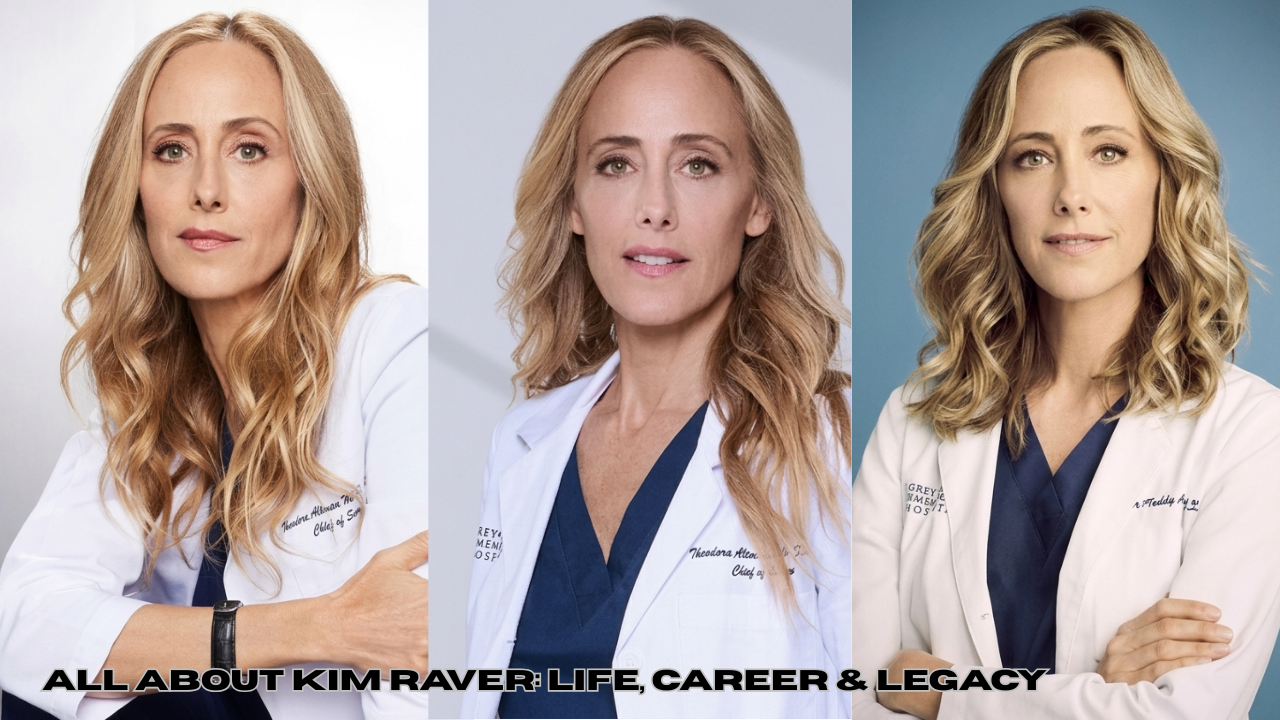
Perhaps the most definitive chapter in the story of All About Kim Raver belongs to the long-running ABC medical drama Grey’s Anatomy. Raver joined the series in its sixth season in 2009, initially in what was intended as a recurring guest role. The character — Dr. Theodora Grace “Teddy” Altman, a brilliant cardiothoracic surgeon and longtime friend of Meredith Grey’s husband — was so compelling that she was elevated to series regular status before the season had even concluded. It was an organic, audience-driven recognition of what the character and the actress brought to the show.
Dr. Teddy Altman: Complexity, Heartbreak, and Resilience
Teddy Altman is one of the more psychologically layered characters in the show’s extensive history. A military-trained surgeon who served in the United States Army, she arrived at Grey Sloan Memorial as a figure of professional authority and personal complexity in equal measure. Her storylines encompassed professional rivalry with Cristina Yang (Sandra Oh), a poignant and ultimately tragic romance with Dr. Henry Burton (Scott Foley), and later a long, complicated entanglement with Owen Hunt (Kevin McKidd) that would evolve — through betrayal, parenthood, and reconciliation — across multiple seasons.
Raver portrayed Altman with extraordinary emotional range, moving from warmth and dark humour to devastation and fury with equal conviction. Her chemistry with McKidd became one of the show’s most discussed relationships, and fans invested deeply in the character’s journey over the years.
Departure, Return, and Directorial Expansion
After three seasons as a series regular, Raver departed Grey’s Anatomy in 2012. Her option had expired and, in the words of creator Shonda Rhimes, both parties felt it was the right moment to give Teddy “a much-needed vacation.” Raver herself expressed warm gratitude for the experience on social media and left with the character’s iconic scrub cap — which she hung above her desk, a keepsake of one of the most meaningful chapters of her professional life.
She returned as a recurring guest star in the show’s fourteenth season in 2017, and then, in May 2018, it was formally announced that she would rejoin the series as a full series regular beginning with Season 15 — making her the first actor in the programme’s history to depart the main cast and subsequently return as a series regular. This distinction alone speaks to the unique place she holds in the show’s legacy. She also extended her role behind the camera, taking on directorial responsibilities for several episodes — a natural progression for an actor of her experience and creative engagement.
In March 2026, it was announced that Raver would depart the series after the Season 22 finale, alongside her long-time co-star Kevin McKidd, bringing a meaningful and much-loved chapter of her career to a graceful close.
Beyond Grey’s Anatomy: A Broader Portfolio
All About Kim Raver is also a story of consistent professional activity beyond her flagship roles. In 2015, she made a guest appearance in the Season 11 premiere of Fox’s long-running procedural Bones. In 2017, she joined the fifth season of the critically acclaimed Showtime drama Ray Donovan as a recurring character, bringing her dramatic sensibility to a very different tonal universe. That same year, she took on the recurring role of Dr. Andrea Frost on the second season of ABC’s political drama Designated Survivor, starring Kiefer Sutherland — a reunion of sorts with her 24 leading man.
She has also appeared in the Grey’s Anatomy spin-off Station 19 as Dr. Teddy Altman in multiple seasons, and lent her voice to the character of Captain Marvel / Carol Danvers in the animated superhero film Marvel Rising: Secret Warriors in 2018 — demonstrating a willingness to explore new formats and genres. More recently, she appeared as Sarah in the 2023 film The Braid.
Her NBC series Revolution also featured Raver in a recurring capacity, adding another network drama to an already impressive list of credits that spans every major American broadcast network.
Personal Life: Marriage, Family, and Private Passions
Away from the professional spotlight, All About Kim Raver reveals a woman of grounded, full-bodied humanity. She has been married to French director and writer Manuel Boyer since 2000, a relationship that has endured across the entirety of her most high-profile professional period. Together they have two sons — Luke West Boyer and Leo Kipling Boyer — and by all accounts, family life has remained a central priority throughout her career.
Her linguistic range reflects her personal history in a beautifully layered way. Fluent in English, German, and French, she absorbed the German language through her German-born mother and the French language through her life with Boyer, creating in herself a multilingual, multicultural identity that informs the depth with which she approaches character work.
Health, Wellness, and Advocacy
Raver has spoken publicly about her commitment to physical wellness, describing running as a mental and emotional discipline as much as a physical one. She has completed half-marathons and views athletic challenge as a form of personal growth — a philosophy that mirrors her approach to professional risk-taking. Yoga is another consistent element of her routine.
She is a passionate animal welfare advocate and has been associated with Maeday Rescue, a non-profit organisation in Los Angeles dedicated to rescuing street and shelter animals. Her pets — a Maltese named Peanut and a Schnoodle named Lulu — frequently appear on her social media, reflecting the warmth and accessibility of her public persona. She has also used her platform to advocate for mental health awareness, speaking openly about the importance of accessible support systems.
A trained tap dancer, an avid hiker, a collector of vintage sunglasses, and an enthusiast of interior design and home cooking, Raver emerges from the full portrait of All About Kim Raver as someone whose interior life is as rich and considered as any character she has ever played.
Legacy, Impact, and What Endures
Evaluating the legacy of a performer still actively working is always a nuanced exercise, but in the case of Kim Raver, certain qualities stand out with particular clarity. She belongs to a generation of television actors who helped legitimise the medium as a serious artistic space — actors whose sustained, committed performances across years and storylines created something closer to the arc of a novel than a series of episodic entertainments.
Her three signature roles — Kim Zambrano, Audrey Raines, and Teddy Altman — are each studies in different kinds of strength. The first is physical, frontline, working-class heroism. The second is intellectual and emotional resilience under political and personal pressure. The third is the messy, complicated, deeply human struggle to reconcile professional excellence with private vulnerability. Across all three, Raver demonstrated a consistent capacity to make strength look earned rather than assumed.
The full scope of All About Kim Raver also includes her work as a director, her mentorship traditions under Wynn Handman, her linguistic versatility, her advocacy work, and her role as a wife and mother — all of which contribute to a public and private identity of considerable integrity. In an entertainment landscape that too often values novelty over depth, she represents something rarer: a performer who chose to go deeper rather than simply to go bigger.
The Measure of a Career Well Lived
When historians of American television eventually compile their definitive accounts of the medium’s golden era, the name Kimberly Jayne Raver will appear with the quiet authority it has always deserved. All About Kim Raver is ultimately a story about staying power — about the difference between fame that arrives quickly and artistry that accumulates slowly, season by season, role by role, through sheer talent and an unrelenting refusal to stop learning. That is the truest and most lasting thing one can say about her.