

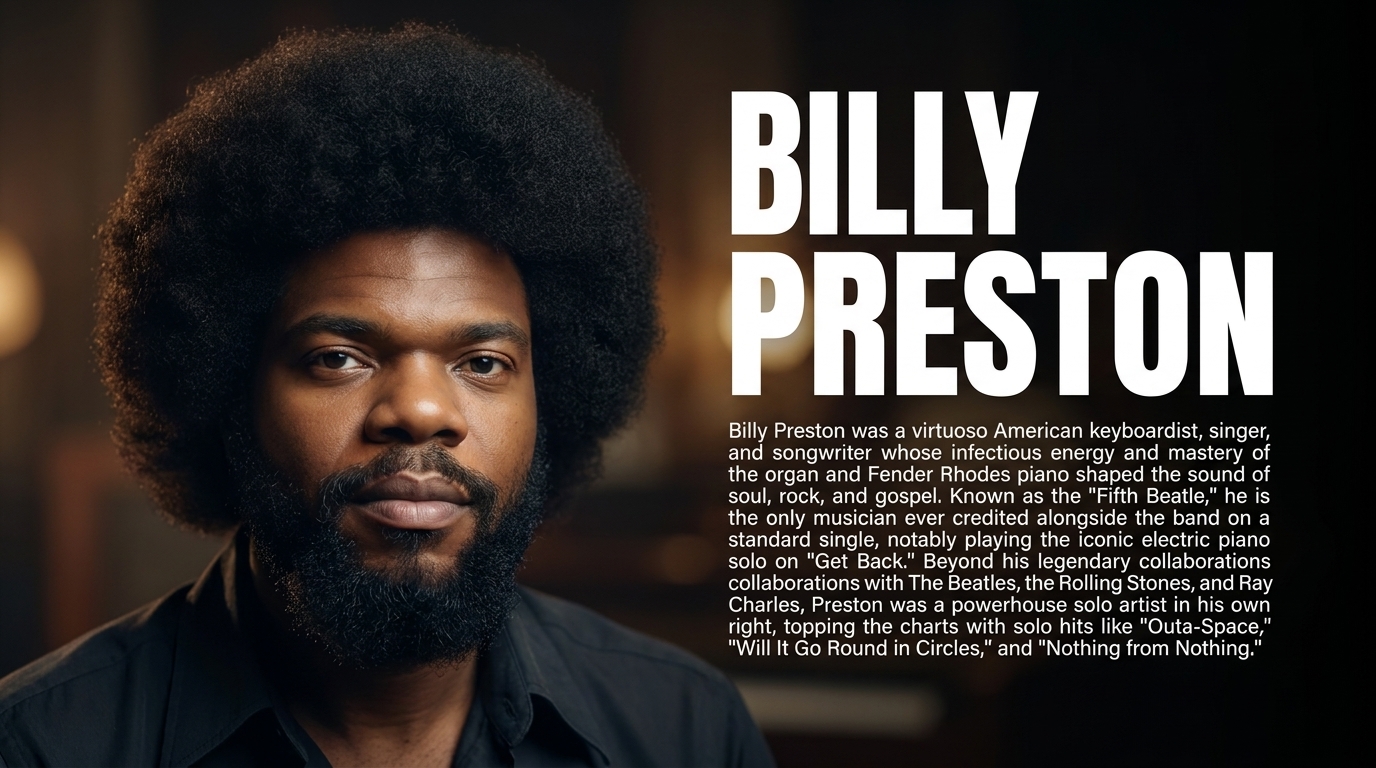
Billy Preston could light up a room with a single chord. His infectious smile, gap-toothed grin, and those flying fingers on the keys turned ordinary sessions into pure magic. Even decades after his passing in 2006, people still talk about him like he just stepped off the stage. In 2026, with renewed interest in his catalog and fresh projects highlighting his influence, Billy Preston remains the ultimate example of talent that transcended genres and eras.
Fans searching for Billy Preston biography or Billy Preston 2026 updates will find his story hits different today. His music still pops up in samples, commercials, and playlists across streaming platforms. His influence feels more relevant than ever as new generations discover that unmistakable funky joy he brought to every track.
Quick Facts
Full Name: William Everett Preston
Age at Death: 59 (born September 2, 1946 – died June 6, 2006)
Birthdate: September 2, 1946, Houston, Texas
Profession: Keyboardist, singer, songwriter, session musician
Nationality: American
Net Worth 2026 (Estate/Legacy Value): Estimated legacy catalog and royalties valued in the millions, building on earlier valuations
Early Life and Education
Billy Preston entered the world in Houston, Texas, but Los Angeles truly shaped him. His mother, Robbie Lee Williams, moved the family there when he was young after separating from his father. Music filled their home from day one.
He started playing piano around age three, sitting on his mom’s lap. Self-taught with no formal lessons, Billy showed prodigy-level skill early on. By ten, he backed gospel legend Mahalia Jackson on organ. At eleven, he appeared on Nat King Cole’s TV show and played young W.C. Handy in the 1958 film St. Louis Blues.
Those early experiences built real discipline and stage presence. Billy absorbed gospel fire, blues soul, and showmanship that would define his sound for decades. He did not follow a traditional school path in music. His education came from church, tours, and raw talent. He attended local schools in LA but lived for the keys.
His childhood mixed joy with challenges. The move to LA exposed him to a vibrant music scene, yet he carried personal struggles quietly. That foundation of faith and family music stayed with him, even as fame pulled him in new directions.
Career Journey and Breakthrough
Billy’s big break came young. In 1962, at 16, he joined Little Richard’s band for a European tour. In Hamburg, he met a scrappy group called the Beatles. That connection would change everything.
Back in the US, he played with Sam Cooke, who signed him for his first solo album 16 Yr. Old Soul in 1963. He became a regular on Shindig! and joined Ray Charles’ band. But 1969 marked his explosion.
The Beatles, struggling in the studio for what became Let It Be, invited Billy in. His organ on “Get Back” added that unmistakable lift. They credited the single to “The Beatles with Billy Preston” — the only time they shared billing with another artist. He joined their famous rooftop concert and played on Abbey Road. John Lennon even joked about making him the Fifth Beatle.
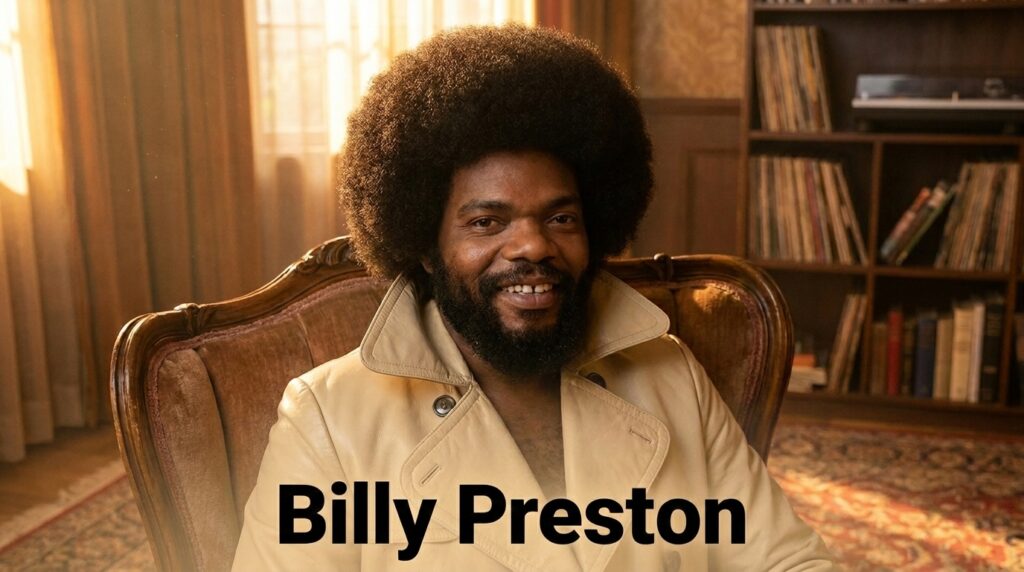
That momentum carried him forward. He signed with Apple Records and released solo work. Hits like the Grammy-winning instrumental “Outa-Space” in 1972, “Will It Go Round in Circles” reaching No. 1 in 1973, and “Nothing from Nothing” in 1974 made him a star. He toured with the Rolling Stones, playing on classics like Sticky Fingers and Exile on Main St. Collaborations with Sly and the Family Stone, Eric Clapton, George Harrison, and more followed.
Billy co-wrote “You Are So Beautiful,” a massive hit for Joe Cocker. He appeared on Saturday Night Live‘s first musical episode. His funky, joyful style crossed boundaries — R&B, rock, soul, gospel. He brought energy wherever he sat at the keys.
Challenges hit in later decades. Addiction struggles led to legal troubles in the 1990s, including time served. Yet he kept performing, touring with Clapton and others into the 2000s. His resilience shone through the pain.
By 2026, renewed appreciation through streaming revivals and special releases keeps his music alive. New documentaries and tribute projects bring his full story to theaters and screens, featuring rare footage and insights from surviving collaborators like Ringo Starr and Eric Clapton. It revives interest and introduces him to new generations.
Net Worth Details
Billy Preston net worth discussions often start with the roughly $1 million figure at his death. But that’s just the beginning. His estate’s value has grown significantly through royalties and catalog streams in the streaming era.
Income came from multiple sources. Solo hits generated steady sales and airplay. Session work with superstars paid well and built long-term royalties. Tours, songwriting credits like “You Are So Beautiful,” and publishing rights added layers. He owned rights that have appreciated nicely over time.
Legal and health battles affected finances during his lifetime. A bankruptcy case dragged on, with settlements in the mid-2010s splitting royalties. His family and longtime manager worked through it, preserving his intellectual property.
In 2026, streaming platforms, samples in modern tracks, and renewed media attention keep his estate vibrant. The Billy Preston Foundation, supported by his sister Lettie, continues to back music education and emerging artists. His legacy extends far beyond dollars — it is cultural wealth that keeps giving to musicians and fans alike.
Personal Life
Billy lived with big love and hidden pain. His faith, rooted deep in the church, guided him but also created inner conflict. He kept his sexuality private for much of his life, only opening up more fully near the end.
Friends described him as warm, generous, and fun-loving. He enjoyed horses, cars, and simple joys away from the spotlight. Yet addiction shadowed his later years. A kidney transplant in 2002 helped temporarily, but complications from hypertension and other issues led to a coma in late 2005. He passed on June 6, 2006, in Scottsdale, Arizona.
His personal story adds real depth. The joy he projected onstage came from genuine struggle. That contrast makes his music even more powerful — pure release and celebration amid life’s messiness.
Interesting Facts
- He never took a formal music lesson yet mastered complex organ and piano techniques that amazed legends.
- Miles Davis wrote a song titled “Billy Preston.”
- He fed the early Beatles during their hungry days in Hamburg.
- His smile and signature afro became iconic symbols of 1970s funk and soul.
- He played on the Beatles’ final live performance during that legendary rooftop show.
- Posthumous recognition continues strong, with 2026 projects revealing new layers of his story and influence.
Billy’s life reminds us that talent alone does not shield anyone from hardship. His ability to channel pain into groove inspires countless musicians today.
FAQ
Who was Billy Preston and why is he called the Fifth Beatle?
Billy Preston was a legendary keyboardist and solo artist who collaborated closely with the Beatles on Let It Be and other tracks. His essential contribution to “Get Back” earned him the rare co-credit, leading to the affectionate nickname that stuck for good.
What is Billy Preston’s net worth in 2026?
At the time of his death it stood around $1 million, but his music catalog, royalties, and ongoing streams have increased the estate’s value substantially into the millions through continued popularity.
What caused Billy Preston’s death?
He died from complications of kidney disease and related health issues after years of struggles, entering a coma in November 2005.
What are Billy Preston’s biggest hits?
Standouts include “Will It Go Round in Circles,” “Nothing from Nothing,” “Outa-Space,” and “Space Race.” His session work on Beatles and Rolling Stones tracks remains hugely influential to this day.
Is there new Billy Preston content in 2026?
Yes. Renewed documentaries, streaming revivals, and tribute projects are bringing fresh interviews, rare footage, and appreciation for his incredible legacy to both longtime fans and new listeners.
Billy Preston did not just play music — he embodied it. His keys carried gospel truth into rock arenas and funk dance floors. In 2026 and beyond, we celebrate not just the hits, but the heart, soul, and groove behind them. Search his name, spin his records, and feel that unmistakable joy. That’s the way God planned it.